I haven't actually put much time into this game since I decided to breath life into this blog. Maybe an hour or so of play time. The main reason for this is the amount of text in this game. I'm not saying it is bad for a game to have a lot of text and story, just usually I tend to reach for my DS when I want a shorter gaming session or I don't have time for a longer gaming session. That is the advantage of hand held systems, is that in theory they support short sessions well. But the amount of text in Radiant Historia makes a short session hard.
I have been finding that a cut scene/ plot exposition point can take from 10 to 20 minutes (probably exaggerating, but they do feel this long) to click through if I read the text at a conversation pace, making the appropriate pauses and all. Which makes sense since the story is revealed through dialogue. How ever, because the cut scenes take a significant amount of time to go through, a short session is hard to do. It wouldn't be as noticeable if these scenes were in frequent, but they are not. In my last hour of play, I went through three cut scenes which amounted to about half the play session. All this means, to make progress, I need to be able to devote at least an hour to every session with the game, and with the cramped controls on the NDS, an hour is about as long as I can go without my hands feeling cramped.
Sure I could use the stylus to control a lot of the action, but the d-pad and buttons feel more natural for this type of game. I don't mean to rag on the game. It is very fun. I just wish it could be played in shorter bursts, if needed. As it stands, this game would have been better suited for a console where long sessions are easier. And its not like jRPGs can not be done well and support short sessions. The ports of Chrono Trigger and Final Fantasy 4 did this well, as did Nostalgia.
Rant over. I would still recommend this game for any jRPG fan. I have stated I am not a huge fan of the genre, yet I find this game very fun. And in essence I wouldn't change the dialogue either. It makes for a good story in this case. I just wish shorter sessions were easier with this game than they are.
Showing posts with label NDS. Show all posts
Showing posts with label NDS. Show all posts
Wednesday, April 6, 2011

Thursday, March 31, 2011
Radiant Historia (NDS): A Unique Concept
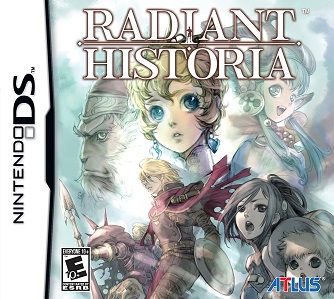
Radiant Historia is a Japanese style RPG developed and published by Atlus. I will admit here that my experience with JRPGs is rather limited and confined mainly to the offerings of SquareEnix and overall I am not really a fan of the genre. I prefer RPGs that allow the player to define the protagonist as they see fit. Being able to at least choose the class and personality of the player. In my limited experience, which consists of dabbling in Final Fantasy, Chrono Trigger and Golden Sun games for the most part, JRPGs are more like adventure games than true RPGs. The stories are linear with predetermined characters who have set personalities. This isn't necessarily a bad thing as it allows for the story to make extensive use of the characters personalities as a plot devise, but it also limits the amount of role playing the player actually gets to participate in. In the end, I have found this genre to relegate the player to directing battles and purchasing gear to allow the story to progress.
That said, I am finding Radiant Historia to be rather enjoyable. The game even gives the illusion of player choice with the split time lines mechanic. This mechanic also happens to be the main gimic of the game, but more on that in a bit.
The plot of Radiant Historia revolves around a war between Alistel and Ganorg. The games backstory states that long ago, the fall of an ancient empire started a process of desertification of the continent on which these two nations reside. As the desert expands the nations fight for what arable land remains. The game follows Stocke, the player character (PC), who is a member of Alistel's Specint unit. Upon setting out on his first assignment, Stocke is given the white chronicle. Stocke soon discovers this book allows him to travel through time and fix mistakes he made during the mission. After completing the first quest, which serves as a turtorial, Stocke must choose whether to remain with Specint or join his former comrade an friend, Captain Rosch's unit in the army. This choice creates two time lines, the real history and the alternate history.
This split time line serves as the main mechanic and plot device of the game. Stocke must use the chronicle to travel between the time lines to insure history follows the correct course. Way points in the time lines are created when the player is presented with a choice of action. Some actions can result in a game over, while others simply allow you to continue and others yet have an impact on the other time line. In the end though, which option you choose at each point is irrelevant as Stocke can always go back to that point and make a different decision.
The other main mechanic is the battle system. In battle, the player is thrown into a turn based combat where the enemies are place on a 3 by 3 grid. By manipulating the order of attack and using different skills, the player can put the enemy in unfavorable positions and unleash combos. This creates a simple, yet deep system that is very rewarding as the player has to balance many different tings.
So far, I have put about 4 hours into the game and I would say it feels like half of that was clicking through dialogue. This isn't a bad thing necessarily, since the story is engaging and the characters are not really annoying as I have found characters in other JRPGs. The amount of dialogue would surely be a detriment if there was no way of skipping it when you go back to make a different choice at a decision point, but since you can rapidly skip the text, I can't complain.
In the time that I have played, I have completed the prologue and started the first chapter for both the alternate history and the real history. In the first chapter of the real history, I saved a merchant who was supposed to make a delivery to the mines, which then allowed me to progress in the first chapter of the alternate history where I had to stop the Granog army from getting through the mine. I haven't really run into any tough battles yet, except for a minor boss fight when rescuing the merchant. Seeing as the boss fled at the end of the fight, I highly suspect that this boss will be the traditional recurring boss fight in which every encounter with him sees him stronger and with some new ability.
The main difficulty in so far has been in attrition. your characters do not recover health or mana over time so to heal, you must stay at an inn, use mana to cast healing spells or use items. You can also use a mana crystal at a save point to fully restore your party, but the crystals are expensive and thus a limited resource in the early game. This forces the player to try and be efficient in combat, even against trash and makes moving around the map strategic as the player decides whether he really should engage that group or try and avoid them.
Overall, I will say this game is promising. Expect another update after I progress a bit more.
Subscribe to:
Posts (Atom)